 121 Ontario St., Frankfort, IL
60423
121 Ontario St., Frankfort, IL
60423 Monday - Friday 8:00am - 4:00pm
 (708) 598-0039


Understanding Chicago’s Reflective Roofing Codes
If you manage a commercial facility or own commercial property in Chicago with a low-slope or flat roof, there are rules and regulations regarding reflective roofing. If you don’t follow those, there are financial consequences that could affect business decisions down the road.
But the codes can be tricky, and the specifics a little complicated, which is why when you’re looking to hire a commercial roofing contractor, you want to ensure you’re staying within the laws.
This guide answers your Chicago reflective roofing code questions, with the regulatory specifics and practical planning insights your roofing contractor should provide.
Chicago’s Energy Transformation Code
Chicago’s Energy Transformation Code governs energy performance standards for both new construction and major roof replacements on commercial buildings. For facility managers, the most operationally significant provision is the mandate for reflective roof covering materials on low-slope commercial roof systems.
The core requirement: when replacing a low-slope roof (defined as a slope of 2:12 or less), the new roof covering must meet minimum Solar Reflectance Index (SRI) thresholds.
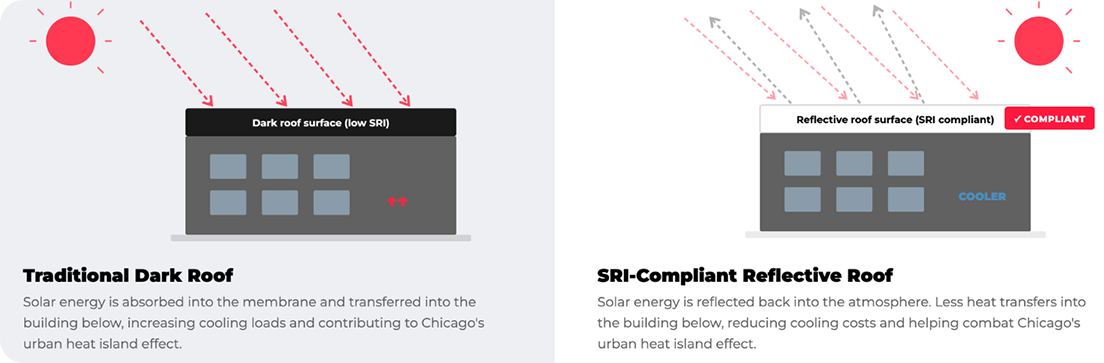
The intent is to reduce the urban heat island effect. That’s where dense urban environments like Chicago’s commercial corridors trap heat, raising ambient temperatures and driving up cooling loads in the buildings beneath.
Chicago’s ETC aligns with ASHRAE 90.1 energy standards and applies to most commercial re-roofing projects, not just new construction. If your existing roof fails and you replace it, the replacement must meet current code.
What Reflective Roofing Actually Means
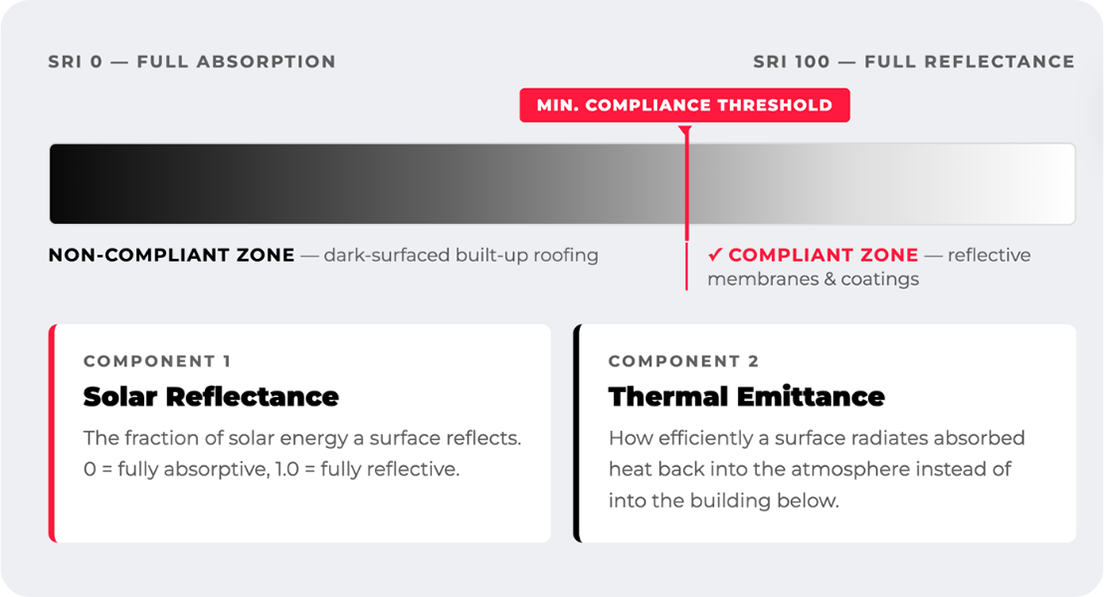
The Solar Reflectance Index (SRI) is a composite measure of a roofing material’s ability to reject solar heat. It combines two properties:
- Solar Reflectance (SR): The fraction of solar energy the surface reflects. A perfectly reflective surface = 1.0; perfectly absorptive = 0.
- Thermal Emittance (TE): How efficiently the surface radiates absorbed heat back into the atmosphere rather than transferring it into the building below.
An SRI of 0 represents a surface that absorbs all solar heat. An SRI of 100 represents a standard white reflective surface.
Chicago’s code requires minimum SRI values, shifting the roofing market away from traditional dark-surfaced built-up roofing and toward membranes and coatings designed to reflect rather than absorb.
For facility managers, if your commercial roofing contractor proposes a dark-surfaced roofing system on a low-slope application without addressing code compliance, that project may fail inspection.
This then creates timeline delays, change-order costs, and potential liability exposure.
What Types of Buildings are Affected by Reflective Roofing Codes
Chicago’s reflective roofing requirements apply broadly to:
- New commercial construction with low-slope roofing
- Full roof replacements (tear-off and re-cover) on existing commercial buildings
- Significant roof modifications that alter the primary roofing membrane
Green roofs (vegetative systems) and certain specialty systems may have alternative compliance pathways.
Commercial Roofing Options
| System Type | Compliance Profile | Best Suited For |
|---|---|---|
| White TPO / PVC Single Ply | Typically SRI 90+. Industry-standard compliant option. | Logistics, warehouse, distribution, office, and institutional facilities |
| EPDM with Reflective Coating | Base EPDM is dark and non-compliant. White coatings bring SRI into compliance. | Existing EPDM roofs nearing the end of life; budget-sensitive projects |
| Modified Bitumen with Cool Cap Sheet | Cool-surface cap sheets with a white or granulated reflective surface. | Heavy-use facilities requiring impact resistance alongside compliance |
| Green / Vegetative Roofing | Alternative compliance pathway. Reduces heat island through evapotranspiration. | Facilities with structural capacity; stormwater credit programs |
| Reflective Roof Coatings (Restoration) | Can bring existing roofs into compliance as part of a restoration program. | Roofs with 5+ years of structural life remaining; CapEx deferral strategy. |
The Dangers of Non-Compliance
There are three key risks of non-compliance: permits and inspections, insurance claims, and unplanned expenses.
Chicago’s Department of Buildings enforces the Energy Transformation Code through the permitting and inspection process.
A roof replacement project that proceeds with a non-compliant system risks failed inspection, stop-work orders, and the cost of tearing off and replacing non-compliant materials.
A roof that was installed without the required permits or outside of code requirements can create grounds for claim denial or reduced settlement when storm damage or leak claims are filed. While not always the case, it’s better to be safe than sorry.
A non-compliant roof that must be replaced outside of the planned capital cycle creates exactly the type of unbudgeted emergency expenditure that disrupts operating budgets and damages a facility manager’s credibility with finance leadership.
Need Commercial Roof Installation or Repair? Trust Chicagoland’s Commercial Roofing Specialists
Ridgeworth Roofing has delivered commercial roofing installation, repairs, maintenance, and more to Chicagoland businesses for over 50 years.
Want to work with a trusted Chicagoland commercial roofing company? Call Ridgeworth Roofing today.

